Psoriasis is a chronic inflammatory disease of the immune system. It develops when the body makes skin cells too quickly, causing skin cells to pile up and form visible patches or spots on the skin.
This disease respects no one, affecting nearly 7.5 million adults and children in the United States alone. You can have any skin tone, be any gender, and still it strikes. Some demographics have slightly higher rates of incidence than others, but overall—when it comes to who it affects, psoriasis just doesn’t care.
And that’s why we care.
Dermatology Center of McKinney helps anyone with psoriasis address its appearance. We work with patients to find appropriate psoriasis treatment in McKinney, while curating over-the-counter and medical-grade therapeutic skincare products that help relieve symptoms and diminish future outbreaks.
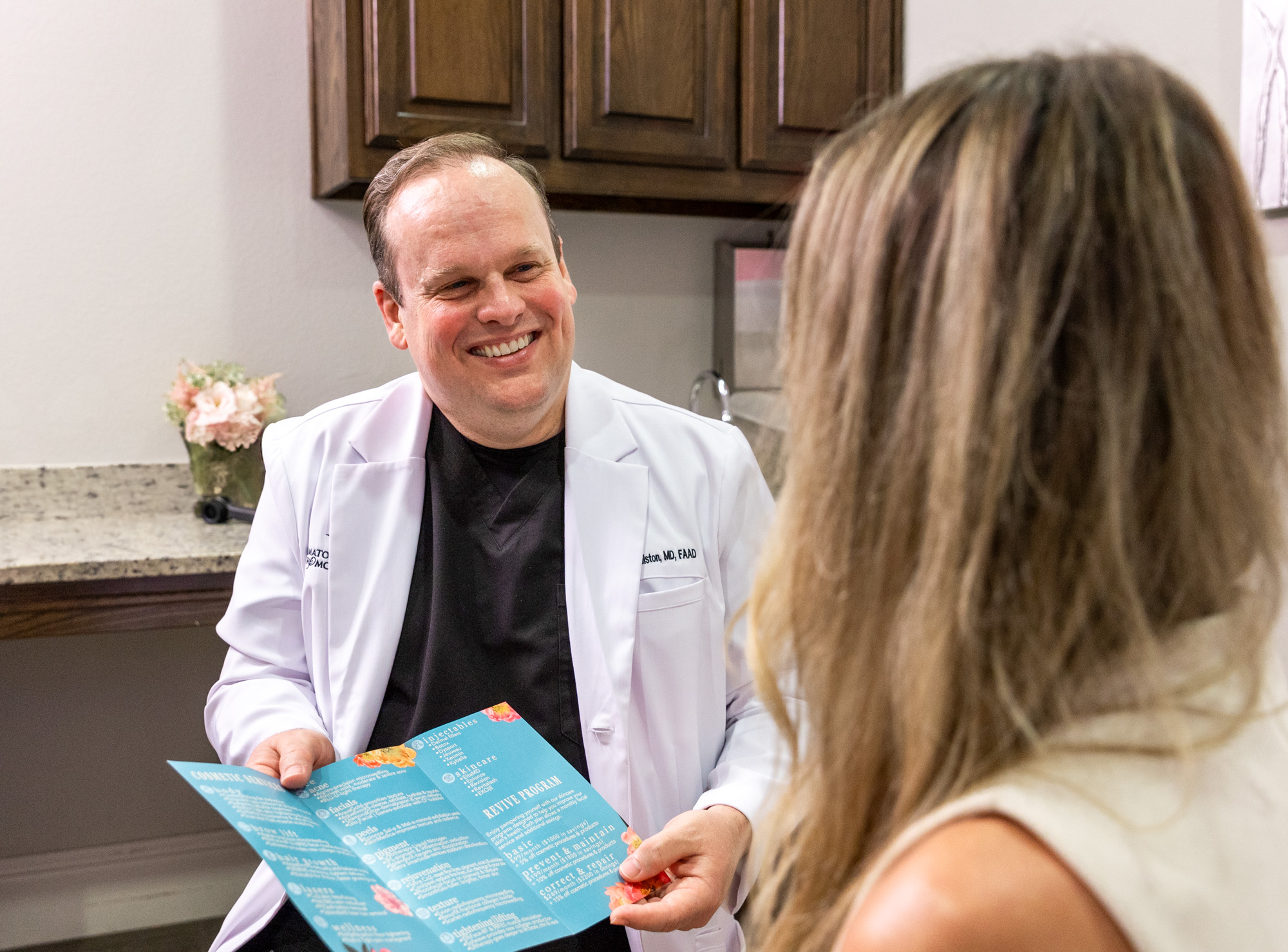
If you have psoriasis or think you might have psoriasis, schedule an appointment for a consultation. A board-certified medical professional will examine your skin concerns, determine their cause, and find the best avenues of treatment in-clinic and at-home for this chronic condition.
How We Address Psoriasis
Psoriasis can come in many forms, including:
- Plaque psoriasis. The most common form of psoriasis, it affects 80 to 90% of psoriasis patients. It is characterized by patches of raised, reddish skin covered with silvery-white scale.
- Scalp psoriasis. Thick, scaly, itchy silvery/white patches on the scalp.
- Pustular psoriasis. Appears as inflamed, pus-filled blisters.
- Inverse psoriasis. Smooth, shiny, red patches in skin folds.
- Guttate psoriasis. Frequently on children, showing small, red, dot-like lesions, usually after suffering strep throat.
Approximately 25 to 30% of people with psoriasis experience joint inflammation that exhibits symptoms of arthritis. This condition is called psoriatic arthritis.
Science hasn’t pinpointed the exact cause of psoriasis; therefore, there is currently no cure for it. However, dermatologists can offer treatments and therapies to help manage the symptoms, and improve your quality of life.
Ongoing Psoriasis Treatment
Your Dermatology Center of McKinney medical providers will help to create a treatment plan that achieves the best results possible for your specific form of psoriasis. Your personalized plan could include any of the following, or a combination of them, to help you achieve relief.
- Topical treatments are helpful for mild to moderate psoriasis. However, they cannot effectively treat more intense moderate to severe psoriasis.
- Psoriasis patients with moderate to severe psoriasis can be treated with traditional systemic medications, which work throughout the body. These can include biologic medications, which also work throughout the body, targeting specific parts of your immune system.
- Phototherapy, utilizing UV light, may also be used to treat moderate to severe psoriasis.
- In cases of more extensive psoriasis, topical agents may be used in conjunction with phototherapy, or along with traditional systemic or biologic medications.
Related topic: Finding the Best Rosacea Treatment in McKinney
Medical Psoriasis Treatment
In McKinney, we also recommend biologics and other medications that can improve your immune system’s dysfunctional response.
Systemic Medications
For severe cases, or conditions that don’t respond to other treatments, we may require systemic psoriasis treatment in McKinney. Though these medications do affect a patient’s whole system, they still can be curated to provide relief with the least amount of side effects.
Biologics for Psoriasis
Biologics are a class of advanced medications that work as highly targeted therapies. They suppress specific parts of the immune system—those that drive inflammation and rapid skin cell growth—while leaving the rest of the immune system alone. Traditional medicines affect the majority of the immune system, leaving a patient more susceptible to other issues.
Our curated biologics can block proteins that cause psoriasis and psoriatic arthritis. We also offer medications that block cytokines and interleukins that are responsible for plaque creation and psoriatic inflammation.
Topical Treatments
Another avenue of itchy skin relief and psoriasis management involves prescription-strength and medical-grade topical creams, salves, and ointments. The 2 most commonly prescribed topical treatments are corticosteroids and vitamin D analogue medicines.
What Topical Corticosteroids Do
This medication reduces the inflammation causing psoriatic build-up.
When added to creams, ointments, and shampoos, corticosteroids work quickly and are highly effective. Their strength and application can be modified for each location, including the face, scalp, knees, and elbows.
What Are Vitamin D Analogues?
These are synthetic forms of vitamin D, such as calcipotriol, created by modifying the structure of calcitriol (a form of Vitamin D) to create a new compound. Their use in topical applications helps slow down overactive skin cell growth.
We often prescribe these products in conjunction with other therapies, including topical corticosteroids, to enhance the effectiveness of the complementary therapy.
Choosing Over-the-Counter Therapeutic Products
To support your psoriasis treatment in McKinney, our team often recommends over-the-counter (OTC) and medical-grade products that help manage psoriasis symptoms at home. These are especially useful for milder symptoms that don’t require prescription-strength therapies.
The most important over-the-counter skincare product is a high-quality moisturizer containing ceramides and/or urea. These ingredients help to:
- Restore the skin barrier
- Reduce transepidermal water loss
- Soften scaling
Using these kinds of moisturizers has been shown to:
- Improve skin hydration
- Decrease itching
- Enhance overall skin appearance
All of which are essential for managing the chronic dryness and irritation associated with psoriasis.
Though the products may differ, there are some key active ingredients we look to for home-based skincare regimen benefits.
Salicylic Acid
If you’ve heard of chemical peels, you’ll understand the gentler mechanism behind salicylic acid. As a keratolytic agent, salicylic acid—typically in the 2 to 3% range—can soften thick, scaly psoriasis plaques characteristic of mild-to-moderate psoriasis. Once they soften, they can be reduced with soft scrubbing.
As these outer skin layers release, the appearance of psoriasis decreases. This capability also allows other topical treatments to penetrate more effectively. It’s often used as a preparatory treatment to make other treatments more effective.
Coal Tar
A classic ingredient for treating psoriasis, coal tar comes from the distillation of coal. This thick, pungent black liquid is added to topical products. These coal tar preparations, 0.5 to 5% in shampoos or creams, slow down the accelerated growth of skin cells. It can also reduce itching, inflammation, and the appearance of white/silvery scales.
Coal tar is particularly useful for scalp psoriasis and body plaques. Though proven to be effective, patients should be advised about potential irritation, odor, and increased photosensitivity. If coal tar products work well for you, you should also use sun protection in conjunction with your coal tar therapy.
Hydrocortizone
This mild corticosteroid temporarily reduces the itching that frequently accompanies psoriasis outbreaks. Because hydrocortisone should only be used for short periods, other anti-itch options include products with menthol or calamine in them.
Related topic: Get the Care You Deserve at Our Skin Treatment Clinic in McKinney
Other Helpful Choices
We may recommend more products that support your psoriasis treatment in McKinney.
Moisturizers should always be applied because they hydrate the skin and reduce cracking and scaling. Well-hydrated skin also decreases the probability of flare-ups. Consider creams, ointments, oils, and/or lotions that are fragrance-free. They usually contain shea butter, hyaluronic acid, glycerin, and other beneficial ingredients.
You can also luxuriate in a colloidal oatmeal bath. Adding this finely-ground oatmeal to a warm bath delivers anti-inflammatory antioxidants that help reduce redness and itching while enhancing moisture retention.
Your Dermatology of McKinney provider will help determine which of these options will be most beneficial for your skin and your goals.
Simple Sunlight Exposure
Sunlight contains UVB rays. This is the spectrum of light that is most beneficial to managing psoriasis in our laser skin treatments. This natural source of UVB rays, when experienced in moderation, can slow skin cell growth during psoriasis outbreaks, reducing the thickness and scaling of psoriasis plaques.
UVB light also reduces the overactive T-cells caused by this immune system malfunction. This lowers inflammation, which helps skin heal.
Keep in mind that overexposure to sunlight, resulting in a sunburn, can exacerbate psoriasis along with leading to an increased risk of skin cancer.
What Is the Best Thing for Psoriasis?
The answer is simple: consult with a qualified dermatologist. Only a board certified medical specialist can diagnose the issues you’re facing. And through their expertise in skin disease care, they can recommend effective and appropriate treatments and therapies for your situation.
At our dermatology and wellness center, we offer plans for psoriasis treatment in McKinney that can involve lasers, medicines, biologics, and more. We have also told patients that their best course of action is over-the-counter products. Our goal isn’t to sell you a service or a product. We’re here to help you achieve healthy skin that looks its best.
We will always do everything within our power to achieve that for your wellness and your self-confidence.
What Are the Most Common Triggers for a Psoriasis Flare-Up?
For preventative measures, we recommend avoiding the following when possible:
- Stress. Psoriasis flare-ups often happen when stress levels are high.
- Lifestyle. Three lifestyle issues lead the pack for triggering psoriasis: drinking, smoking, and obesity.
- Infections. As with younger children, infections like strep throat can trigger guttate psoriasis.
- Medications. Some medications can worsen psoriasis.
- Injuries. Abrasions, cuts, and even sunburns can cause psoriasis plaque formation at the injury site.
Don’t Wait. Instead, Understand and Transform.
Understanding your skin concerns is half the battle for psoriasis treatment in McKinney. Rely on the doctor-owned, patient-focused Dermatology Center of McKinney to discover your underlying causes and triggers. Then, we can create a personalized treatment plan that gives you relief and results for personal transformation.
Dr. James P. Ralston, M.D., F.A.A.D., leads a team specializing in skincare treatments spanning psoriasis to skin cancer identification, and aesthetic treatments that bolster your skin’s best features. Contact us by scheduling a consultation online, or just give us a call. Either way, it’s time you met with the man voted top dermatologist in McKinney.